



Fast & Free delivery

Usually fulfilled in 24 hrs

Arrives in a week or less
Fast & Free delivery
Usually fulfilled in 24 hrs
Arrives in a week or less
Fast & Free delivery
Usually fulfilled in 24 hrs
Arrives in a week or less
Fast & Free delivery
Usually fulfilled in 24 hrs
Arrives in a week or less
Fast & Free delivery
Usually fulfilled in 24 hrs
Arrives in a week or less
Fast & Free delivery
Usually fulfilled in 24 hrs
Arrives in a week or less


Frequently Asked Questions
What makes this raised garden bed different from others?
Certainly, the beds have no bottom. This design facilitates drainage, preventing root rot, and encourages worms to enter the bed. Opting for bottomless beds supports plant roots in accessing nutrients below the ground.
Can I move or reconfigure the bed after assembly?
Typically, raised beds are less than a foot tall, insufficient for robust root growth—particularly in areas with poor soil quality.
Deeper soil promotes healthier plants with longer roots. Additionally, taller beds reduce the need for bending over, providing a back-saving advantage.
Does the metal get too hot and harm the plants?
Determining the number of raised beds depends on factors like available space, the type and quantity of plants you intend to grow, and your gardening objectives.
Assess the dimensions of your gardening area, consider the space requirements of your chosen crops, and factor in any preferences for organization or design.
Planning ahead ensures that you create an efficient and aesthetically pleasing garden layout while meeting your specific cultivation needs.
Is this product safe for growing vegetables?
Certainly, raised beds are versatile and suitable for growing a variety of plants beyond vegetables. You can cultivate flowers, herbs, fruits, and even ornamental plants in raised beds, offering flexibility and creativity in your garden design.
Do I need special tools to assemble it?
The 6-in-1 modular raised bed design offers versatility with six different configurations, ensuring adaptability to suit the specific requirements of your space.
Are the beds safe to grow food in ?
No Soil Contamination: Unlike treated wood and plastic, Aluzinc material remains stable even in extreme temperatures, ensuring no chemical leaching into plants or soil.
Additionally, Gro-Rite Raised Beds uses USDA-approved paint, making it an ideal choice for organic gardening.
Will the beds get too hot in the summer or hot climates?
No, they don't. Gro-Rite Beds outperform traditional wooden, concrete, and plastic beds, especially those crafted from dark-colored materials, in efficiently regulating a steady and cool soil temperature.
The enhanced reflectivity of the material prevents most of the heat from penetrating the soil.
As the soil promptly absorbs and disperses internal heat, the robust corrugated steel panels play a pivotal role in this process.
Will the raised beds rust?
Aluzinc material resists rusting and corrosion due to its composition of a steel substrate coated with a combination of aluminum, zinc, and magnesium.
This protective coating forms a barrier that shields the underlying steel from exposure to oxygen and moisture, preventing the oxidation process that leads to rust.
The combination of aluminum and zinc creates a corrosion-resistant alloy, enhancing the material's durability and longevity in various environmental conditions.
How long will Gro-Rite Raised Beds last?
Gro-Rite Raised Beds are made out of Aluzinc steel which boasts a lifespan beyond 20 years primarily due to its unique composition.
What are Gro-Rite Raised Beds made of?
Gro-Rite Garden metal raised beds utilize a Zinc, Magnesium, and Aluminum-coated steel construction.
The rods, crafted from naturally rust and corrosion-resistant stainless steel, receive an additional layer of USDA-approved paint for enhanced longevity and protection.
How do I assemble my Gro-Rite Raised Bed?
The ease of assembling Gro-Rite Raised Beds is what we pride ourselves on.
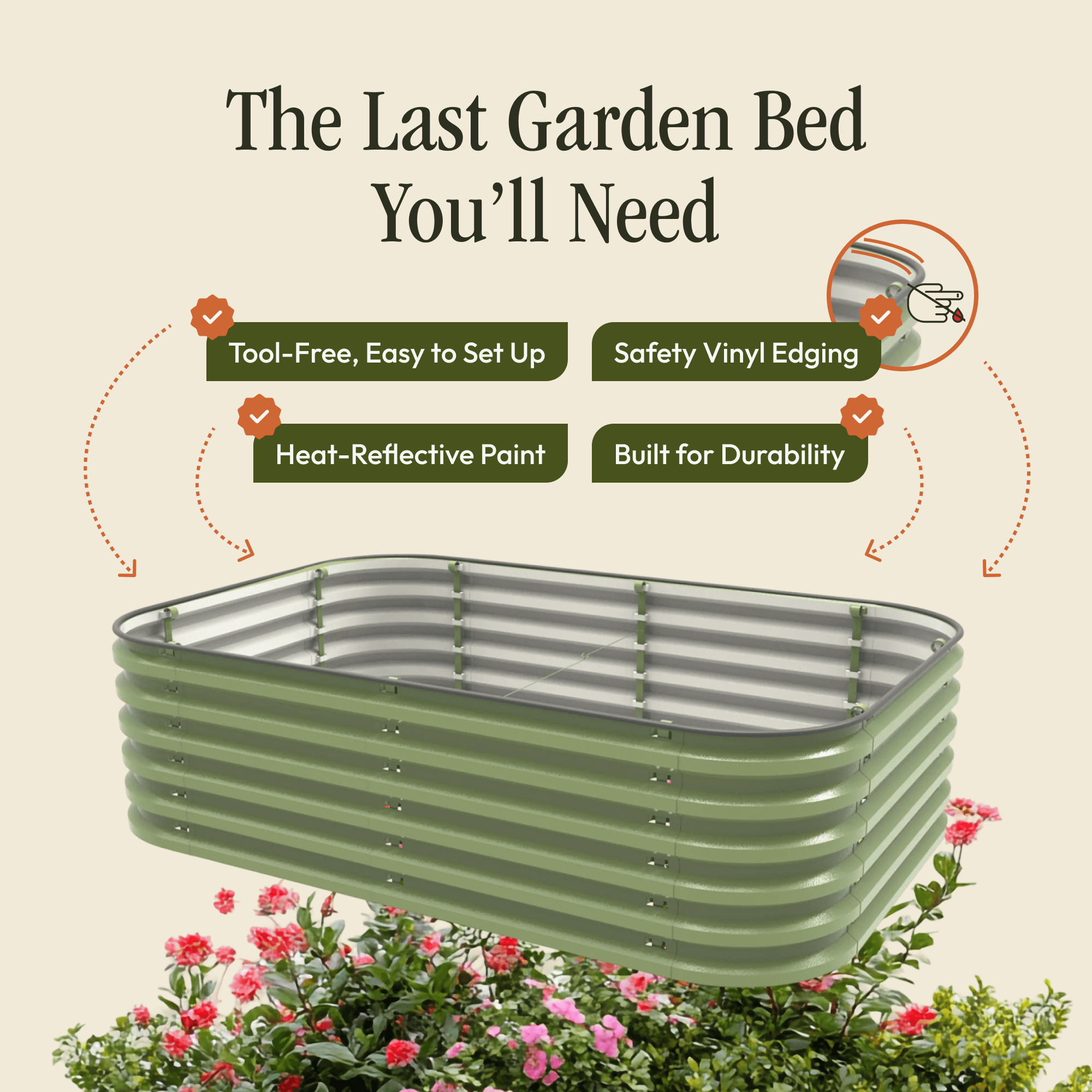
Simply layout the desired configuration, overlap the cutouts on the panels over the notches, and slide the rod down through.
Assembling Gro-Rite Raised Beds can be done in less than 10 minutes and is intuitive enough that some may not need instructions.
What is "Pop N Slide" technology?
"Pop N Slide" technology is a phrase we coined to describe the unique process in which our raised beds are put together.
The "pop" refers to the sound of the panels overlapping and the "slide" refers to the stainless steel rod that moves down the corrugate connecting the two panels.
How do I fill my raised bed for low cost?
To fill a raised bed on a low budget, consider these cost-effective options:
- Topsoil: Purchase bulk topsoil from a local supplier to fill the majority of the bed.
- Compost: Use homemade compost or seek municipal composting programs for an affordable organic option. (This could added after the topsoil)
- Manure: If available, incorporate well-rotted manure from local farms, which adds nutrients to the soil.
- Mulch: Place a layer of mulch on top to retain moisture and suppress weeds. Shredded leaves or straw can be economical choices.
- Local Resources: Check for free or low-cost resources like wood chips, grass clippings, cardboard, or fallen leaves in your community.
By combining these elements, you can create a nutrient-rich soil mix for your raised bed at a reasonable cost.
Check out our blog post about the Hugelkultur method for a step-by-step guide on filling your raised bed cost efficiently.
What types of surfaces can the beds be placed on?
Gro-Rite Raised Beds can be positioned on various surfaces, such as grass, soil, concrete, pavers, or tiles.
For optimal results, it is recommended to place your Gro-Rite bed on top of grass or soil.
Can I place the beds on concrete or a balcony?
Yes, the only downside is that the soil may leave stains on the floor.
If you're placing your garden bed on concrete, consider lining the bottom with landscaping fabric to prevent soil seepage.


